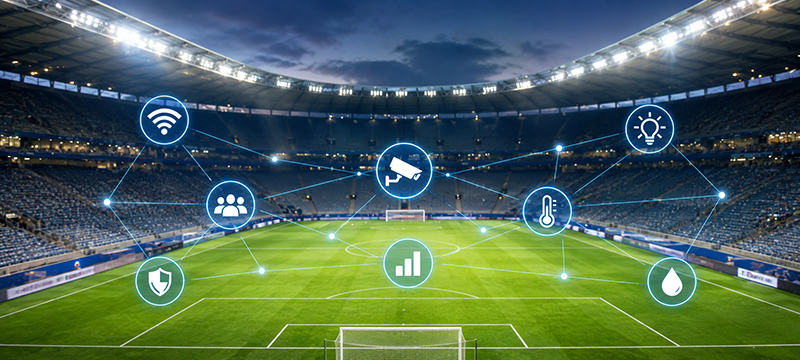
Deutsche Telekom IoT is positioning the 2026 FIFA World Cup as a practical reference point for connected stadium operations, spanning parking, logistics, building systems, mobility, safety and fan services. The significance is less a single product launch than a view of how global IoT connectivity, 5G and real-time data may have to work together across complex event environments.
Stadium digitalisation is often described through the fan experience: faster entry, better apps, smoother payments and more targeted information. The harder problem sits underneath those visible services. A major tournament requires transport systems, venue operations, building infrastructure, security processes, concession logistics and mobile networks to perform at the same time, under short peaks of demand and across multiple jurisdictions.
That is the context for Deutsche Telekom IoT’s latest smart-stadium narrative around the 2026 FIFA World Cup, which will be hosted across the United States, Canada and Mexico. With 48 teams and 104 matches, the event provides a useful stress case for IoT architectures because it combines high-density venues with cross-border travel, temporary operational peaks and the need for consistent digital services around stadiums rather than only inside them.
From connected venue to connected event district
Telekom’s framing is notable because it does not treat the smart stadium as a single building automation project. The company describes an operating model that starts before kick-off, continues during the match and extends into post-event clean-up and safety. In that model, IoT sensors can monitor pitch moisture and sunlight, autonomous mowers and line-marking robots can use positioning data, and connected logistics systems can support the movement of pallets, catering supplies, merchandise and technical equipment inside the venue.
Outside the stadium, the same connectivity layer is applied to parking, lighting and mobility. Telekom points to AI-powered parking sensors, electric-vehicle charging integration, connected LED systems that adjust to light conditions and visitor numbers, and shuttle services using LiDAR, cameras and precise positioning data. During the event, building management systems aggregate sensor inputs for lighting, ventilation, energy use, maintenance and cleaning. After the match, video-based analysis and other sensor data can support crowd exit management, while connected emergency equipment and waste bins report status or fill levels.
What makes this different from a typical smart-building or fan-app announcement is the breadth of the operational perimeter. Telekom is effectively presenting the stadium as part of a temporary smart city district, where car parks, access roads, service areas, energy systems, public transport links and visitor guidance tools all become part of the event infrastructure.
Connectivity is the architectural issue
The most important technical point is not simply that more sensors are being added. It is that the 2026 tournament spans three countries, making device connectivity, roaming, provisioning and platform integration more complex than for a single domestic venue. Telekom highlights global IoT connectivity, international partner and roaming networks, 5G, private 5G campus networks and high-precision positioning based on mobile and satellite data as components of the overall approach.
A concrete implication follows from that mix: no single network technology is likely to cover every stadium use case. Low-power sensors used for parking or fill-level monitoring have different requirements from real-time fan services, autonomous service vehicles or high-density mobile usage by spectators. For IoT teams, the practical challenge is therefore orchestration: matching the right connectivity option to the application, while keeping device management, data security and operational visibility consistent across the estate.
Telekom also notes that aggregated and anonymised visitor movement data may be used for flow analysis where permitted by regulation and applicable data protection requirements. That caveat matters. Crowd analytics in a stadium environment can be valuable for safety and routing, but it also requires governance around data minimisation, anonymisation and local compliance, especially in a tournament that crosses national borders.
Why IoT stakeholders should care
For OEMs, the message is that stadium-related devices increasingly need to fit into broader operational ecosystems rather than operate as isolated products. Parking sensors, cleaning robots, lighting controllers, charging systems and safety assets must be connectable, manageable and supportable in environments with fluctuating demand.
For connectivity providers and system integrators, the opportunity is in stitching together public cellular IoT, 5G capacity, private networks, positioning services and cloud platforms without creating separate operational silos for each use case. Enterprises and venue operators, meanwhile, should read the scenario as a reminder that smart-stadium ROI is not limited to fan-facing services. Energy management, logistics efficiency, maintenance coordination, parking utilisation, safety readiness and post-event clean-up can all be part of the business case.
Telekom’s World Cup scenario should not be read as a confirmed deployment blueprint for every venue. Its value is in showing how many operational domains now depend on reliable connected infrastructure. For large events, the smart stadium is becoming less about one impressive application and more about whether the invisible systems around the venue can work together when tens of thousands of people arrive, move, consume services and leave within a compressed window of time.
 ChatGPT