


New analysis from IoT Analytics argues that industrial downtime is increasingly tied not only to machine failure, but to the loss of maintenance know-how as experienced technicians retire. The research points to AI-assisted knowledge capture, prescriptive maintenance and richer asset-health data as emerging responses.
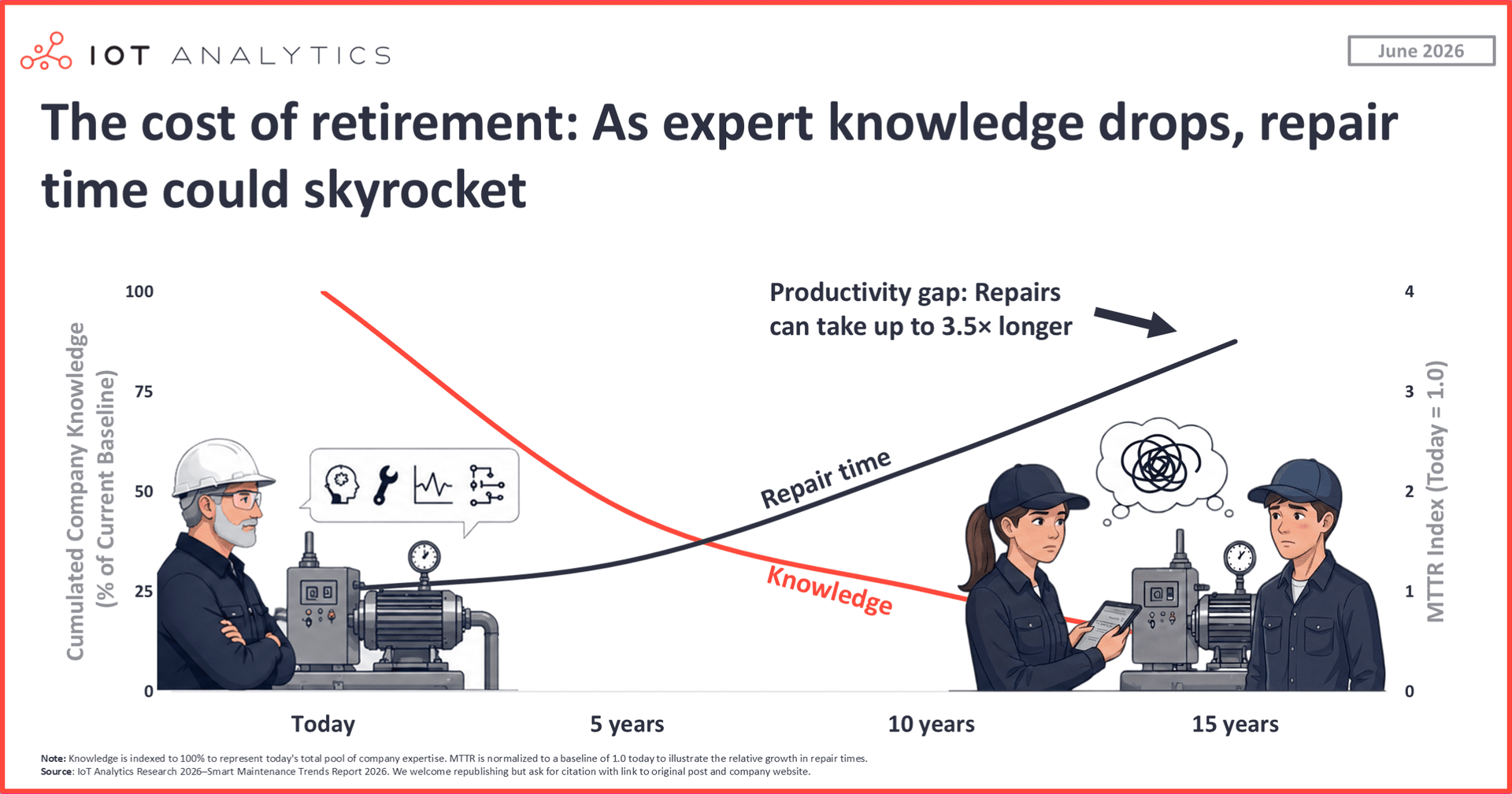
For years, the industrial IoT maintenance story has been framed around prediction: add sensors, monitor vibration or temperature, detect anomalies, and intervene before production stops. That logic remains valid, but it does not fully address a more human constraint now becoming visible on the factory floor. Knowing that a fault is coming is only part of the problem; knowing how to diagnose and fix it is becoming just as critical.
IoT Analytics’ latest analysis, drawing on its upcoming Smart Maintenance Market Report 2026 and observations from Maintenance Dortmund 2026 and Hannover Messe 2026, puts this shift in sharp terms. The firm estimates unplanned industrial downtime costs manufacturers around $1 trillion globally each year, but argues that the next maintenance bottleneck is knowledge loss rather than prediction accuracy alone.
The distinction matters. Typical predictive maintenance announcements focus on models, sensors or alerts. The more specific development identified here is the movement from fault detection toward the digitization of technician expertise: repair procedures, machine-specific troubleshooting experience, calibration history, manuals, SOPs and undocumented judgment that historically lived with senior maintenance staff.
From predictive alerts to operational memory
The analysis cites several examples of vendors addressing this gap in different ways. Bassetti Group’s TEEXMA for Maintenance is positioned as a modular CMMS platform with knowledge retention as a core function. Hexagon is using AI to transcribe and curate video recordings of experienced technicians, making hands-on know-how searchable for newer staff. Augmented Industries’ Flow Tool converts machine manuals and SOPs into interactive troubleshooting guides.
That is a different proposition from simply improving the F1 score of a predictive model. The practical objective is to reduce the dependency on a specific individual being available when a machine fails. A logical implication for industrial operators is that maintenance AI projects will increasingly resemble knowledge-management programs as much as analytics deployments. The critical asset is not only sensor data, but the context that turns an alert into a safe and effective repair action.
IoT Analytics also highlights the rise of prescriptive systems that recommend corrective actions. Infinite Uptime’s PlantOS, for example, extends predictive maintenance by adding validated action plans such as replacing a bearing or adjusting lubrication. Nanoprecise has demonstrated an LLM-based analysis layer linking equipment health issues to diagnostic steps and recommended actions. Emerson, meanwhile, is described as enabling operators to build custom AI agents that analyze available data streams and generate operational recommendations, while characterizing autonomous AI control as an upcoming shift rather than a current native offering.
Data quality is becoming the real AI project
The report’s most useful warning is that AI will not compensate for weak industrial data foundations. Fragmented asset hierarchies, inconsistent equipment taxonomies, spreadsheet-based calibration records and disconnected manuals all limit the reliability of AI-assisted maintenance. IndySoft’s decision to focus on accurate internal records before adding external LLM tools illustrates this more cautious approach. Hexagon is also limiting AI access to proprietary customer data until hallucination risk is better controlled.
For OEMs and industrial software vendors, this changes product priorities. Competitive differentiation may come less from adding a chatbot interface and more from helping customers structure asset data, link documentation to equipment records, and preserve validated maintenance actions. For system integrators, the work shifts toward building the knowledge layer between OT data, IT systems and frontline workflows.
Connectivity providers also have a role, particularly as wireless sensing expands monitoring to assets that were previously uneconomic to instrument. IoT Analytics notes growth in wireless vibration monitoring, while examples from SKF, Status Pro Maschinenmesstechnik, WIKA and Schaeffler show different approaches to battery life, radio choices, retrofit monitoring and asset-health ecosystems. The point is not that wireless replaces wired instrumentation; the report explicitly notes that wired and wireless layers remain complementary, especially where safety, temperature or load variability impose limits.
Cloud architecture becomes part of the maintenance product
Another concrete deployment issue is cloud hesitancy. Many AI-enabled maintenance systems require cloud connectivity, yet European industrial operators in particular may resist third-party cloud integration because of cybersecurity or data sovereignty concerns. Schaeffler’s use of cellular gateways to send sensor data directly to the cloud, bypassing customer IT networks, and Status Pro’s MQTT split configuration for routing data to private servers show how architecture is becoming a product feature.
For manufacturers, the takeaway is pragmatic. AI may help preserve maintenance knowledge and shorten repair cycles, but only where the underlying information is captured before experienced staff leave, cleaned into usable structures, and embedded into tools technicians will actually use. The firms that wait until after the knowledge has walked out of the plant will still be able to deploy sensors and predictive models. What they may lack is the operational memory needed to act on the alert.
 ChatGPT