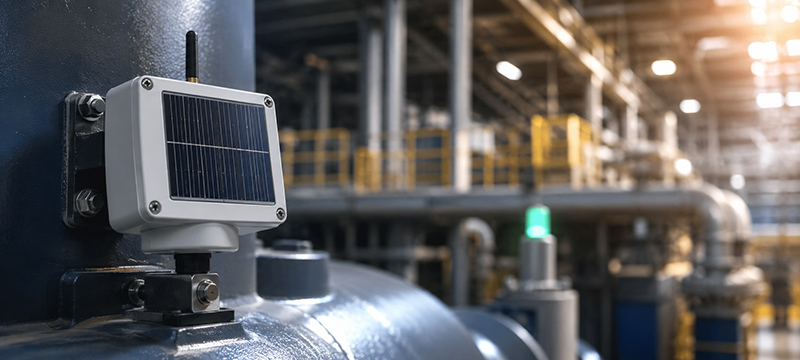
 New engineering blueprint explores how energy harvesting can eliminate maintenance costs and battery waste in distributed sensor networks.
Battery maintenance is emerging as one of the biggest barriers to large-scale Industrial IoT (IIoT) deployments, according to electronic design and software consultancy ByteSnap Design.
As organisations increase the use of connected sensors across industrial environments, the operational burden of maintaining thousands of battery-powered devices can quickly undermine project economics.
In response to growing demand from hardware developers facing rising maintenance costs and tightening environmental regulations, ByteSnap Design has published a new engineering blueprint, “Energy Harvesting: The Key to Maintenance-Free Industrial IoT”.
Written for hardware developers, design engineers and system architects, the blueprint examines the commercial and logistical challenges of powering large-scale, distributed sensor networks in remote, inaccessible and hazardous environments. It also covers power budget calculations, supercapacitor selection, and the energy requirements of wireless protocols including LoRaWAN, Zigbee, BLE and NB Cellular.
Advances in ultra-low-power silicon, power management and energy harvesting now enable industrial devices to operate for years using ambient energy sources such as vibration, heat and light, removing the need for routine battery replacement altogether.
ByteSnap Design notes that commercial perovskite photovoltaic cells are now achieving efficiencies of up to 38% under indoor lighting conditions, significantly increasing the viability of self-powered industrial sensors. The company believes this development is helping to accelerate the adoption of maintenance-free IoT deployments in warehouses, factories and other indoor industrial environments.
To demonstrate the practical viability of energy harvesting, the blueprint includes a case study from a UK rail project where ByteSnap Design engineered a zero-maintenance trackside backup system. By combining solar, wind and train-induced vibration, managed by an Analog Devices energy harvesting IC and supported by a supercapacitor, the system successfully powers LoRa transmissions while avoiding the need for routine trackside maintenance.
Dunstan Power, Director of ByteSnap Design, stated: “The strict power budget realities that engineering teams must evaluate during the initial architecture phase are extensive. Devices drawing microamps with milliamp pulses can run indefinitely, but anything requiring more than 10 mA continuous draw is simply not viable in remote or hard-to-reach locations. That’s why energy harvesting is essential, making hybrid systems that combine photovoltaic, vibration, and thermoelectric inputs today’s baseline for maintenance-free industrial IoT.”
Harvesting energy is only half the battle, though. The other is extreme conservation, which is driving the integration of Edge AI. ByteSnap Design showcased a live Edge AI vision system at the Design Engineering Expo at the NEC recently demonstrating real-time object detection and identification running entirely on embedded hardware without cloud processing.
Powered by an Infineon PSOC™ Edge device, the demonstration used an embedded camera system and a rotating turntable to detect and identify objects in real time, with results displayed instantly on screen. The project highlighted how computer vision and on-device ML inference can be integrated into low-power embedded systems for industrial and connected applications.
The engineering blueprint includes ByteSnap Design’s project feasibility calculator, enabling engineering teams to assess whether an energy harvesting approach is viable for their application. The blueprint also includes the full rail case study, protocol comparisons to support early-stage design decisions.
 ChatGPT