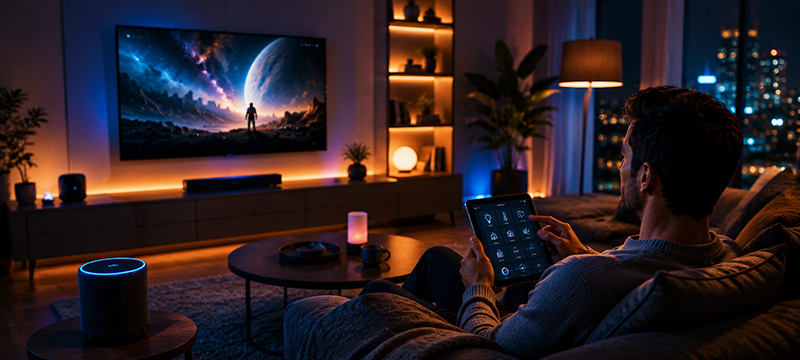
Smart homes have transformed everyday convenience in countless ways. From switching off the lights, adjusting the heating, to locking the front door, or alerting you when a parcel arrived, many useful features were there to transform our lives.
Years later, the connected home system is taking up much more space in people’s lives thanks to fully integrated entertainment systems. Homes are now where films premiere, friends gather virtually, sports unfold across multiple screens, music follows people from room to room, and games begin in seconds. Once the place people left to be entertained, is becoming the destination itself.
Transformation of the Living Room
Entertainment mostly requires leaving home to go to the cinema for a film, a concert hall for music, an arcade for games, a casino for tables and slots, or a sports bar for the atmosphere of a big match. Some people still prefer going to a physical address for these activities. But it is not the only option anymore or the most convenient one.
Since a smart TV can open Netflix, YouTube, Twitch, a sports stream, or a cloud gaming service in seconds, spending hours for a cinema outing has become a rarity for many. A gaming console can connect friends across countries. A laptop can host a Discord watch party. A tablet can carry live statistics while the main screen shows the game. Licensed online casino games and betting apps are on a whole other level when it comes to digital entertainment.
And this is not just a small behavioral change. Deloitte’s 2026 Digital Media Trends survey found that US consumers are paying for an average of four subscription video services, while “fans” spend more time and money on entertainment than non-fans. That tells us something important: the entertainment economy is built around repeated, connected, multi-platform engagement.
Smart TVs Are the Entertainment Gateway
Since the invention of smart systems, TV is no longer a screen waiting for a cable signal. It is the center of the digital entertainment of our homes.
Parks Associates reported in January 2026 that 61% of US internet households now use a smart TV as their primary streaming video device, and it is easy to understand why. Smart TV is where streaming services, games, and channels compete for attention.
Fortune Business Insights report supports this trand. According to the estimates, the global connected TV market size will grow from $359.1 billion in 2026 to $505.31 billion by 2034.
Technology Has Made It Easier
Not long ago, renting a movie from a physical shop was a routine event. Today, a tap, a voice command can do the same thing. Deloitte’s 2026 Digital Media Trends survey found that 90% of US households have a paid subscription video-on-demand service, with an average of four services per household. This shows the powerful change in home entertainment systems and their effect on the global market.
Convenience changes behavior. When entertainment starts instantly, people consume it more casually and more often. A person may not plan an evening around one film, but they will watch an episode while eating. They may not travel to a concert, but they will stream a live performance. They may not gather at a bar for every match, but they will watch highlights, track scores, and comment in a group chat from the sofa.
The Home Is Becoming an Experience
Smart home systems not only play content, but they can create the whole experience. One command can dim the lights, lower the blinds, adjust the temperature, launch surround sound, start a film, and order food.
This is where IoT changes the meaning of entertainment. A traditional home cinema setup offered better picture and sound. A smart home adds atmosphere. It turns the living room into a private theatre, a gaming arena, a fitness studio, or a music lounge, depending on the moment.
We No Longer Consume One Thing at a Time
The idea of “watching TV” is behind us now. The living room has become a platform for overlapping experiences. An evening at home may include a film on the main screen, a football score on a phone, a PlayStation session later, and a group chat running throughout.
This is also why digital entertainment markets keep expanding across categories. The online gambling market, for example, is estimated by Mordor Intelligence at $121.93 billion in 2026, with projections of $211.99 billion by 2031. The report links this growth to smartphone adoption, 5G rollout, and increasingly harmonized regulation in major jurisdictions.
The important point is not that every household uses every service. It is that the home has become flexible enough to host them all. Cinema, gaming, music, sport, social interaction, fitness, gambling, and shopping now sit inside the same connected domestic ecosystem.
What This Means for IoT Businesses
Fortune Business Insights projects that smart entertainment devices will dominate the smart home market in 2026, with a 28.78% share. North America also held 31.70% of the global smart home market in 2025. For IoT companies, that creates an obvious business opportunity. Smart TVs, speakers, lighting systems, thermostats, routers, sensors, and apps are judged by the experience they create together, not their individual performance.
A speaker is more useful when it follows the user from the kitchen to the living room. A TV becomes more important when it acts as a gateway to streaming, gaming, music, commerce, and home control.
The smart home is no longer managing domestic tasks. It is creating environments. The future smart home will not just turn the lights on; it will ask what kind of evening you want.
 ChatGPT