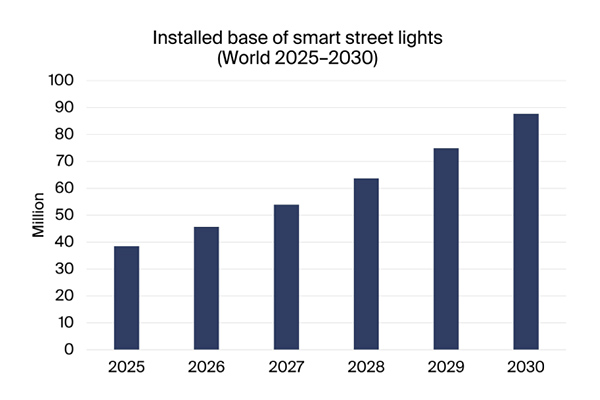
The global installed base of individually controlled smart street lights reached 38.5 million units in 2025, with Berg Insight forecasting rapid growth through 2030 as connected lighting becomes a more common component of LED modernisation projects.
Street lighting is increasingly moving from simple scheduled illumination toward individually managed infrastructure, where each light can be remotely monitored and controlled. That transition is turning lighting control units into a sizeable IoT endpoint category while also creating a connectivity market spanning proprietary RF mesh and cellular technologies.
New figures from Berg Insight show that the installed base of individually controlled smart street lights reached 38.5 million units worldwide at the end of 2025. The IoT analyst firm expects the total to rise at a compound annual growth rate of 17.9 percent to 87.6 million units by the end of 2030.
Europe leads smart street lighting adoption
Europe accounted for 36 percent of the worldwide installed base in 2025, making it the largest regional market. North America represented another 29 percent, while China alone accounted for approximately 15 percent.
Those figures illustrate how smart street lighting has already moved beyond isolated smart-city pilots. Berg Insight says lighting control units are increasingly being included as a standard specification in new LED modernisation and replacement projects in a growing number of markets.
This is an important distinction from many smart-city IoT deployments, where connectivity is added as a separate digitalisation layer. In connected street lighting, the control unit is increasingly being deployed as part of the underlying lighting upgrade itself. That creates an opportunity to expand the connected infrastructure base each time municipalities or utilities replace conventional lighting with LED systems.
Energy costs, sustainability targets and concerns about the environmental impact of public lighting continue to support adoption. Berg Insight also points to operational benefits as an important driver among utilities, particularly in North America.
A concentrated top tier in a fragmented vendor market
Signify had the largest installed base at the end of 2025, with around 6.2 million lighting control units. The company moved into the leading position following its acquisition of Telensa in July 2021.
Itron and China’s Fonda Technology completed the top three, with half of Fonda Technology’s lighting controllers deployed in its domestic market. Together, the three largest suppliers accounted for almost one-third of the worldwide installed base.
The wider competitive landscape remains fragmented. Berg Insight identifies more than 100 vendors in the smart street lighting market, while only a small number have surpassed one million deployed lighting control units. Other suppliers cited by the analyst include Ubicquia, Acuity Brands, Dimonoff, LED Roadway Lighting, Schréder, CityLight.net, Revetec, DigitalPlatforms, Flashnet, Rongwen Energy Technology Group and ST Engineering Telematics Wireless.
Cellular connectivity gains ground
The connectivity mix behind those deployments is also evolving. Proprietary RF mesh technologies still represent a large proportion of installed systems, reflecting their use in many major projects deployed during the past decade. Berg Insight nevertheless expects cellular technologies to become the fastest-growing connectivity category in the market over the coming years.
According to the analyst firm, cellular is becoming a more established option because of its plug-and-play characteristics, broad network availability and increasingly attractive cost structure.
For municipalities, utilities and system integrators, that changes part of the deployment equation. Where an RF mesh architecture requires the lighting network itself to provide local communications infrastructure, cellular connectivity can make use of existing public mobile network coverage. In projects where reducing network deployment complexity is a priority, that difference can become significant as thousands of geographically distributed lighting controllers are added or replaced.
The forecast therefore points to more than growth in the number of connected street lights. As individually controlled lighting becomes increasingly integrated into routine LED replacement programs, smart street lighting is developing into a large-scale IoT infrastructure market in which connectivity architecture, device lifecycle management and operational simplicity will become increasingly important purchasing considerations.
 ChatGPT