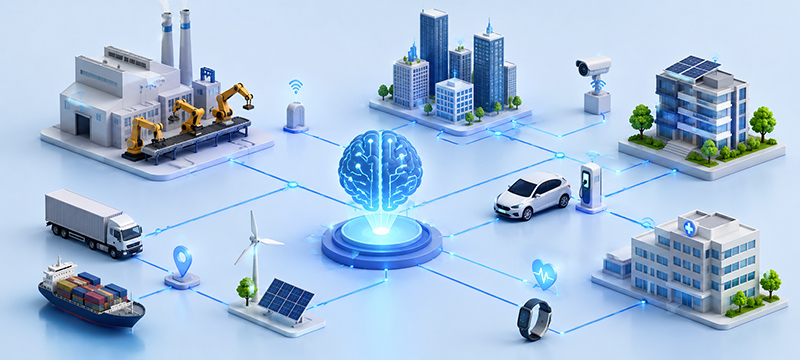
The Internet of Things (IoT) has revolutionized the way enterprises operate. It has enabled businesses to collect huge volumes of new kinds of data from physical assets. Whether on factory floors or in smart cities, thousands of connected devices are continuously transmitting data that can be visualized on centralized dashboards. Yet a major operational constraint remains: most of these connected infrastructures still rely entirely on fixed, preprogrammed automation rules, which require frequent human intervention to handle unexpected situations. When an anomaly occurs beyond the scope of standard if-then logic, it is the human operators who must intervene to analyze and fix the problem. This not only consumes valuable corporate resources but also results in delayed response times.
As a result, companies are deploying autonomous AI agents as the layer of cognitive intelligence in connected environments. Unlike passive analytics tools or simple automation, these advanced AI agents can understand complex data flows, manage distributed networks of connected devices, and make decisions independently and in real time. They do not simply inform managers about a problem; they solve it themselves. This article explains how AI agents can transform traditional IoT infrastructures, which are, first and foremost, data-gathering systems, into intelligent, self-optimizing ecosystems that add substantial business value.
Why IoT Needs AI Agents
Nowadays, just gathering data isn’t sufficient for having an operational advantage in modern IoT environments. Virtually all sensor data becomes meaningless very quickly if it is stored in a cloud database and then waits for a scheduled weekly review or a human-triggered query execution. To cover this gap, enterprises that take the lead are stepping up investment in intelligent software systems that can monitor IoT devices nonstop, analyze multi-modal sensor data, coordinate complex cross-platform workflows, detect subtle operational anomalies, and automate critical decisions in highly connected environments. This cognitive layer enables enterprises to realize the full benefit of their hardware investments.
Embedding autonomous AI agents into the core of IoT networks allows companies to move from merely reacting to situations to aiming to prevent them and even to autonomously manage operations. While conventional systems can only inform you about a machine breakdown after the fact, an agent-driven ecosystem can detect subtle changes in vibration or temperature, infer that a breakdown is imminent, and autonomously reroute workflows to other assets even before downtime occurs. This way, the operational model shifts from dealing with emergencies to carrying out effortless, ongoing optimization that requires no constant supervision by either engineering or IT teams.
Key IoT Use Cases for AI Agents
With the help of AI agents, a very broad set of connected environments is supported, and a baseline of intelligent agility is delivered to different industry verticals. For example, in smart manufacturing and industrial asset management, agents continuously monitor asset conditions to perform maintenance before faults occur. At the same time, they can order materials and schedule repairs without human intervention, avoiding a line stoppage due to a lack of parts. In logistics and fleet management, agents find the best route in real time based on live traffic and weather data, as well as the load’s state, to reduce fuel consumption and prevent spoilage of perishable goods.
The handover of edge orchestration to autonomous agents significantly reduces the time between data reception and action. Beyond industry, agents enable substantial efficiency improvements in energy optimization, smart buildings, and healthcare monitoring.
For example, in commercial real estate, an AI agent can analyze weather forecasts, occupancy grids, and real-time energy prices, then balance the HVAC and lighting systems. As a result, it lowers carbon footprints. In healthcare, agents continuously monitor patient wearables, distinguish noise from useful data, and notify medical providers only when the patient’s vital signs indicate a serious medical emergency. Finally, these varied examples illustrate how AI agents enable organizations to be more agile in changing environments while significantly improving efficiency and reducing costs.
From Connected Devices to Autonomous Operations
The evolution of automation, traditionally linked to IoT, to a stage where decision-making is highly intelligent, can be considered one of the greatest milestones for enterprises’ digital transformation. Legacy IoT largely relies on centralized event orchestration, in which a single cloud server issues inflexible instructions to devices based on predetermined parameters. Apart from that, agent-empowered IoT relies on real-time reasoning and multi-agent collaboration, enabling local systems to communicate, negotiate, and problem-solve laterally. This is the moment when many companies either capitalize on their digital transformation or lose out. With the emergence of AI, automation and decision-making that used to be “dumb” have become smarter through real-time, local, and decentralized processing. With agents and AI at the edge, they can also perform complex workloads directly on local hardware/gateway routers. This way, operations will not be interrupted even if the cloud connectivity is lost.
When you combine edge intelligence with the agility of workflows, you get an entirely new way for systems to handle unexpected disruptions in the operational environment. Rather than presenting an error code and waiting for a remote administrator, an autonomous system coordination structure enables multiple agents to exchange information and dynamically adjust workloads. Let’s say a robotic arm in a warehouse sorting area slows down due to a minor component failure; other robotic agents physically near it will automatically synchronize their processing speeds and reroute items to maintain the highest possible throughput. All of this happens autonomously with very few interventions; at the same time, it becomes a driver of organizational responsiveness at unprecedented speed, in a fast, dynamic environment.
Challenges of Integrating AI Agents with IoT
For enterprises to deploy intelligent automation at scale, it is not sufficient to simply put isolated AI models in a cloud sandbox. Autonomous decision-making agents increase the attack surface, causing cybersecurity and data quality issues. For example, a single corrupted sensor data point might cause an AI agent to execute incorrect operational commands throughout a facility.
Aside from this, organizations face strict edge-computing constraints and complex data-governance and scalability issues. For one thing, large language models and complex neural networks require substantial computational power, which is scarce on low-power microcontroller units (MCUs) deployed in remote field sites. But to make production-ready AI agents work successfully in complex IoT ecosystems, technology leaders need to develop layered architectures. First, quantized lightweight models for localized edge inference must be used; zero-trust security systems should be maintained; and, lastly, strict operational guardrails should be established to limit the agents’ autonomous authority to safe, pre-approved parameters.
The Future of Intelligent Connected Systems
AI agents are drastically changing the Internet of Things landscape, as they help connected systems operate with independence, flexibility, and situational understanding unthinkable even a few years ago. By handing over the everyday work from human operators to autonomous software entities, businesses can effectively turn their physical networks from silent, passive data-collecting pipes into lively, self-healing, and profit-making business resources.
In the end, those organizations that, through foresight, integrate their infrastructure of connected devices with cutting-edge AI agents will achieve higher levels of end-to-end automation, operational efficiency, and structural scalability. With ever-growing enterprise data volumes, adopting AI agents is no longer merely an innovative tech trial but the next strategic move for developing a genuinely future-ready IoT ecosystem.
 ChatGPT