

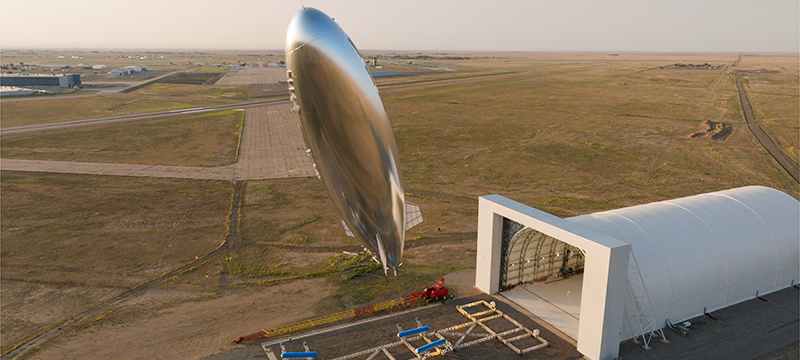
Sceye and SoftBank have completed a stratospheric connectivity demonstration in Japan combining direct-to-device mobile broadband, onboard edge processing and communications with drones from a High-Altitude Platform System.
Non-terrestrial connectivity is increasingly extending beyond satellites. High-Altitude Platform Systems, or HAPS, occupy a layer much closer to the ground, where an airborne platform can potentially provide wide-area coverage while remaining integrated with conventional mobile network infrastructure. The technical challenge is not simply keeping a platform in the stratosphere, but making it behave as part of an operational communications network.
Sceye and SoftBank have now tested that model over Japan using Sceye’s Service Test 1 (ST1) platform. The HAPS flew more than 15,000 km from New Mexico to Japan in 13 days before delivering mobile broadband through SoftBank’s core network to standard, unmodified devices.
From airborne coverage to network integration
The demonstration included text messaging, voice calls, internet access and video streaming using SceyeCELL, the company’s stratospheric communications system. Sceye says a full-scale platform is designed to cover an area equivalent to approximately 500 terrestrial towers.
More significant from an IoT and network architecture perspective is the breadth of the trial. The companies also tested emergency communications, connectivity with drones and computing directly onboard the HAPS. The platform operated at approximately 16.5 km altitude and remained within Japanese managed airspace for more than seven days.
This distinguishes the trial from demonstrations focused primarily on establishing an airborne radio link. Sceye and SoftBank tested interaction with an operator core network, direct connectivity to existing devices, aerial communications and edge processing on the same stratospheric platform.
Putting edge computing into the stratosphere
For the edge computing test, a server installed on the HAPS processed data locally rather than sending it to an internet-connected cloud environment. The companies reported an average round-trip processing response time of 68 milliseconds, more than 40% lower than the cloud-processing configuration used for comparison.
According to the companies, the test was the first in which both a mobile core network and a web server were installed on a HAPS, allowing processing to take place onboard before the result was returned to smartphones.
The architectural implication is important. A HAPS capable of hosting compute resources becomes more than an airborne access point. It can also move processing closer to devices operating across areas where terrestrial infrastructure or cloud backhaul may be unavailable, constrained or disrupted. That could be relevant to applications involving drones, remote industrial operations and disaster response, where connectivity and local processing may need to remain available together.
A third layer for non-terrestrial networks
HAPS sits between terrestrial cellular infrastructure and satellite networks, giving operators another option for extending coverage. For IoT deployments, this creates the possibility of hybrid architectures in which devices move between ground networks and non-terrestrial coverage without requiring every remote application to depend exclusively on satellite connectivity.
SoftBank has been pursuing stratospheric communications for several years and invested in Sceye in 2025. The latest trial therefore represents more than another flight test: it combines Sceye’s ability to position and operate a platform in the stratosphere with SoftBank’s mobile network infrastructure.
Commercial deployment will still depend on operational, regulatory and economic considerations beyond the capabilities demonstrated in Japan. But for OEMs, operators and IoT solution providers evaluating future NTN architectures, the test shows how HAPS could eventually function as an integrated network and computing layer rather than simply as a coverage extension in the sky.
 ChatGPT