IoT stopped being just a collection of sensors a while ago. It’s now a full infrastructure stack that runs from the physical network up through distributed, cloud-native backend systems.
The global IoT ecosystem is projected to include roughly 21 to 29 billion connected devices by 2026, with the industrial IoT market alone valued at $514.4 billion in 2025 and growing at a 16.8% compound annual rate, according to DemandSage’s 2026 IoT statistics report. Behind every one of those devices sits a chain of infrastructure decisions that determines whether the data they generate makes it somewhere useful.
That chain has two ends. On one side is connectivity: the physical network that moves sensor data off the factory floor or away from the remote well site. On the other is observability: the tooling that keeps the resulting distributed, often container-orchestrated systems running once that data arrives. Most conversations about IoT infrastructure treat these as separate topics. They aren’t. A deployment that gets the network right but can’t see into its own backend is just as exposed as one running on unreliable connectivity in the first place.
The Connectivity Foundation: Why IoT Infrastructure Starts with the Network
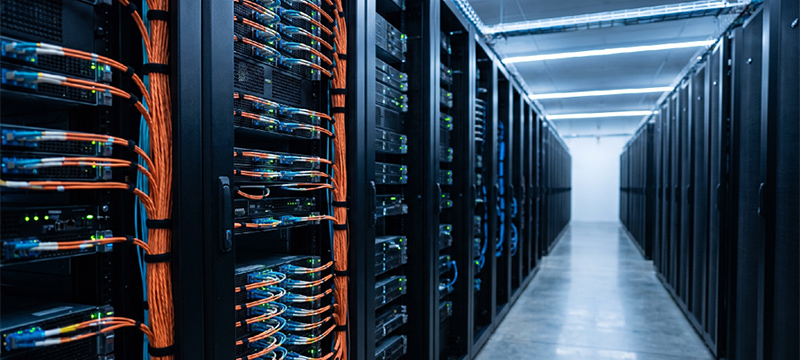
Dedicated fiber connections can give IoT deployments consistent bandwidth and low latency where these characteristics are required.
Connectivity failures are a common reason IoT projects stall before they scale. A survey of 450 global businesses testing IoT deployments across agriculture, utilities, mining, and transport and logistics found that 75% reported connectivity failures during rollout, according to TechRadar’s 2025 reporting on IoT project disruptions. That’s the majority of projects hitting a wall before the technology gets a fair test.
Network issues also contribute significantly to broader infrastructure downtime. The Uptime Institute’s Annual Outage Analysis attributes 23% of impactful outages in 2024 to IT and networking problems, and for large enterprises, downtime can cost between $9,000 and $23,750 per minute, according to research compiled by The Network Installers. When an IoT deployment spans thousands of endpoints reporting in real time, a shaky connection can mean missed safety alerts or corrupted telemetry that engineers won’t catch until it’s too late.
The math behind uptime tiers explains why. At 99.9% uptime, a network can still rack up roughly 8 hours and 46 minutes of downtime per year. Drop to 99.5%, and that climbs to 43.8 hours, nearly two full days offline, according to FiberFed’s breakdown of SLA and uptime mechanics. Some dedicated fiber services, by contrast, offer 99.99% uptime with repair windows built into the service level agreement.
That gap matters more for IoT than for almost any other workload, because IoT systems generate continuous, time-sensitive data rather than occasional bursts. A retailer running inventory sensors, a logistics fleet tracking cold-chain temperatures, or a manufacturer monitoring equipment vibration all need a connection that doesn’t drop out when it matters most. For enterprises with high-bandwidth or availability-sensitive IoT and M2M deployments, fiber internet for business can provide dedicated bandwidth and SLA-backed uptime as part of the connectivity mix. Shared connections may work well for lower-priority deployments but can become a constraint as traffic volumes and availability requirements increase.
The FCC’s gigabit and fiber fact sheet outlines some of the characteristics that have driven the adoption of fiber for business connectivity, including symmetric upload and download speeds and high-capacity connections.
From Devices to the Cloud: How IoT Data Flows Through Distributed Infrastructure
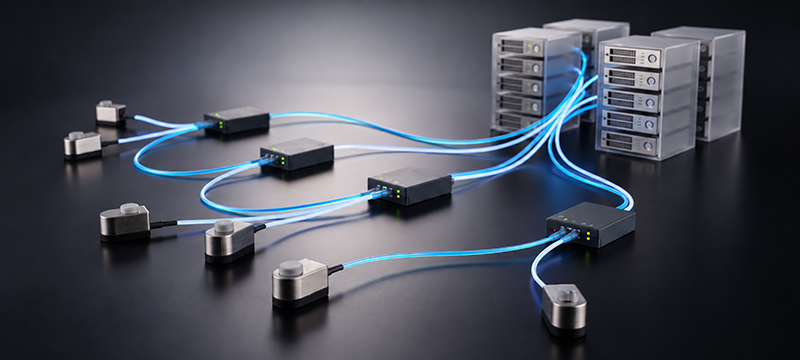
Modern IoT architectures move data from field sensors through edge nodes into containerized cloud environments.
Once the connectivity problem is solved, the data still has somewhere to go. Most modern IoT architectures don’t send raw telemetry straight to a central data center. Instead, they distribute processing closer to connected devices, an approach our recent piece on edge computing for IoT architecture breaks down, filtering data at the edge before forwarding a smaller payload to the cloud.
That shift has changed what “backend infrastructure” means for an IoT deployment. Instead of a handful of monolithic servers, most teams now run a mesh of containerized microservices that ingest telemetry, run analytics, and trigger alerts across multiple regions at once. Kubernetes has become a widely adopted way to orchestrate that mesh. The Cloud Native Computing Foundation’s 2025 Annual Survey, published in January 2026, found that 82% of container users now run Kubernetes in production, up from 80% in 2024 and 66% in 2023.
Device fleets rarely grow in a straight line. A pilot with fifty sensors can become five thousand within a year if the use case proves out, and the backend needs to scale with it without a rebuild. Container orchestration gives teams that elasticity, spinning up processing capacity as device counts grow and shrinking it back down during quieter periods.
The Hidden Complexity: Orchestrating and Scaling IoT Backend Systems
Elastic scaling solves one problem and introduces another. A Kubernetes cluster processing IoT telemetry might run dozens or hundreds of pods across multiple nodes, each handling a slice of ingestion, transformation, or storage. That’s a lot of moving parts, and it’s why selecting the right platform to manage a growing device fleet, a decision our guide to IoT platform capabilities and vendor selection walks through, matters as much as the network layer underneath it.
Kubernetes adoption isn’t a niche choice anymore. 77% of Fortune 100 companies now run Kubernetes in production, according to the same CNCF-sourced research from Portworx’s enterprise adoption analysis. What started as infrastructure for web-scale software companies is now standard tooling for manufacturers, logistics operators, and utilities running IoT at scale. That complexity—dozens of interdependent services, autoscaling policies, multi-region failover—is the price of building something that can grow with device demand instead of falling over at the next expansion.
Keeping Distributed Systems Visible: The Role of Monitoring in IoT Infrastructure
Here’s the tradeoff nobody mentions when they talk about container orchestration: the more distributed the system, the harder it is to know what’s happening inside it. A single server failure is easy to spot. A slow memory leak in one pod out of three hundred, quietly degrading performance across a cluster processing sensor data from a thousand devices, can go unnoticed for days without the right visibility.
That’s the operational risk IoT teams run into once their backend outgrows a handful of servers. Resource exhaustion, latency spikes, and container restarts don’t announce themselves. They show up as delayed alerts or dashboards that quietly stop updating, and by the time someone notices, the cost has already been paid. Given that downtime for large enterprises can run $9,000 to $23,750 per minute, a monitoring gap is a direct line to real financial exposure.
This is why teams running IoT workloads on Kubernetes clusters can benefit from dedicated Kubernetes monitoring tools that track cluster health, container performance, and resource usage in real time rather than relying on periodic manual checks. The right monitoring setup catches a pod nearing its memory limit before it crashes and flags a node that’s silently dropping packets, giving engineering teams the granular, per-container visibility that generic infrastructure dashboards don’t provide. For a system processing continuous telemetry from thousands of devices, that visibility is what keeps a distributed IoT backend from becoming a black box.
Bringing It Together: A Resilient, Observable IoT Infrastructure Stack
Reliable connectivity and real-time observability aren’t competing priorities; they’re two halves of the same problem. Reliable connectivity gets data off the device and into the system. Monitoring keeps the system that receives it running once it’s there. Skip either one and the other’s value drops fast: a perfectly monitored backend can’t do much if half the sensor fleet keeps dropping offline, and a reliable network connection doesn’t help if nobody notices the Kubernetes cluster behind it starting to fall over.
Enterprises modernizing data center infrastructure to support connected systems, a trend our earlier coverage of IoT’s impact on data centers examined, are increasingly building both layers in from the start rather than treating connectivity and observability as separate projects. NIST’s guidance on IoT cybersecurity reinforces the same point: dependable, visible infrastructure is easier to secure because problems get caught before they cascade.
Neither layer is a one-time purchase. Device fleets grow, backend architectures evolve, and the network and monitoring requirements that worked for a 500-device pilot won’t necessarily hold at 50,000 devices.
Conclusion
IoT digital transformation doesn’t succeed or fail on the strength of the use case alone. It succeeds or fails at the infrastructure layer, in the reliability of the network moving data off devices and the visibility teams have into the systems processing that data once it arrives. Enterprises that pair dependable business connectivity with proactive monitoring of their Kubernetes-orchestrated backends are positioned to scale IoT initiatives reliably through 2026 and beyond. The ones that treat either piece as an afterthought tend to find out the hard way, usually during an outage, how much they were relying on it.
 ChatGPT