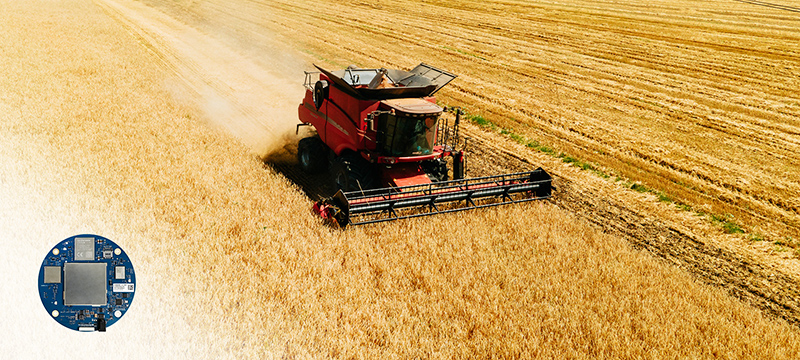
Quectel has introduced the QLM290P, a pre-validated platform combining high-precision GNSS/RTK positioning, LTE and LoRa connectivity. The approach is intended to reduce the RF and communications integration work normally required when building precision positioning equipment.
Centimeter-level positioning is only one part of the engineering challenge behind autonomous machines and other precision IoT systems. An RTK-based product also needs antennas, RF circuitry and a communications path capable of delivering correction data, with those elements ultimately having to be validated as a complete system.
Quectel is addressing that integration problem with the QLM290P, a smart antenna device that brings high-precision GNSS/RTK positioning, LoRa connectivity and global LTE connectivity onto a single pre-validated PCBA. Cellular connectivity also provides a direct route to NTRIP/RTK correction services.
Moving integration above the component level
The distinction from a conventional GNSS module is important. Instead of supplying the positioning component and leaving the OEM to build the surrounding RF, antenna and cellular architecture, Quectel is packaging several of those functions into a ready-to-integrate platform.
In a conventional RTK design, developers may need to design GNSS RF circuitry, select and tune an antenna and integrate a separate cellular subsystem to receive correction data before validating the complete design. The QLM290P is intended to replace much of that work with an already integrated starting point.
This changes where engineering effort can be concentrated. For an autonomous robot or agricultural machine, for example, the positioning subsystem does not itself provide the application intelligence that differentiates the finished product. Reducing the amount of RF integration required can therefore allow OEM engineering teams to devote more resources to navigation software, machine control and application-level integration.
That is also the practical trade-off behind the platform approach. Rather than giving manufacturers maximum freedom to assemble GNSS, antennas and communications components independently, Quectel is offering a more consolidated architecture in exchange for less system-level integration work.
LTE provides the correction-data path
The embedded LTE connection has a specific role beyond general device connectivity: it can provide access to NTRIP/RTK correction services without requiring a separate communications subsystem. This is particularly relevant because an RTK receiver does not operate in isolation; maintaining high-precision positioning depends on receiving correction information from an appropriate source.
The platform can also be configured as either a base station or rover station using the embedded LTE module. Quectel is targeting applications including robotics, precision agriculture, mining, surveying and autonomous driving, where accurate positioning can form part of a broader connected control or navigation system.
LoRa adds another communications option alongside LTE, giving equipment designers a short-range or local wireless channel within the same platform. The combination is more significant than simply adding multiple radios: GNSS, correction-data connectivity and local communications are functions that would otherwise potentially occupy separate parts of the product architecture.
A different route to precision IoT design
High-precision GNSS vendors have increasingly pushed RTK capabilities into smaller modules, but the QLM290P represents a different level of integration. Its emphasis is not solely on improving the GNSS receiver itself; it is on reducing the engineering boundary between positioning, antennas and communications.
For OEMs and system integrators, the practical benefit could be a shorter path from prototype to a deployable positioning subsystem, particularly where internal RF engineering resources are limited. Connectivity providers also remain part of the architecture because LTE is used to reach correction services in the field, while LoRa can support communications within local deployments.
Quectel’s approach illustrates a broader shift in IoT hardware development from discrete wireless components toward more integrated functional platforms. In applications such as autonomous equipment and precision agriculture, where connectivity and positioning are tightly linked operationally, packaging those capabilities together can remove integration work without changing the fundamental requirement for application-specific navigation, control and system validation.
 ChatGPT