
Omdia research shows that enterprise edge computing is increasingly moving into production, with 78% of edge IoT deployments now beyond the pilot stage. Security and integration, rather than budget constraints, are emerging as the main obstacles to broader scale.
For enterprise IoT, the challenge around edge computing is beginning to change. The question is increasingly less about whether workloads should move closer to devices and operational systems, and more about how distributed computing infrastructure can be secured, integrated and managed once deployments extend across multiple sites and business units.
New research from Omdia suggests that transition is already well underway. In a survey of 570 IoT decision-makers across ten countries, 62% of organizations reported adopting edge architectures, while 42% identified edge processing as their top technology investment priority.
More significantly, 78% of respondents with edge IoT deployments said their projects had progressed beyond the pilot stage. More than half, 53%, have reached moderate-to-extensive scale across business units or the wider enterprise, while 87% said their deployments were meeting or exceeding expectations.
Edge shifts from experiment to infrastructure
The figures point to a notable change in the role of edge computing within IoT architectures. Edge processing has long been associated with use cases where latency, bandwidth costs or unreliable cloud connectivity make centralized processing impractical. Increasingly, it is also becoming part of the infrastructure required to support AI and machine learning workloads close to operational data sources.
This evolution is particularly relevant as enterprises consider where inference and analytics should take place. Processing data locally can reduce the amount of information that must be transmitted to cloud platforms while allowing applications to respond more quickly to events generated by machines, sensors and other connected assets. Our broader guide to edge computing for IoT examines these architectural trade-offs in more detail.
What distinguishes Omdia’s findings from many edge technology announcements is that they focus on deployment maturity rather than new hardware or computing capabilities. The important signal is not simply the 62% adoption figure, but the proportion of organizations that have already moved their edge environments into operational use.
Scaling exposes a different set of problems
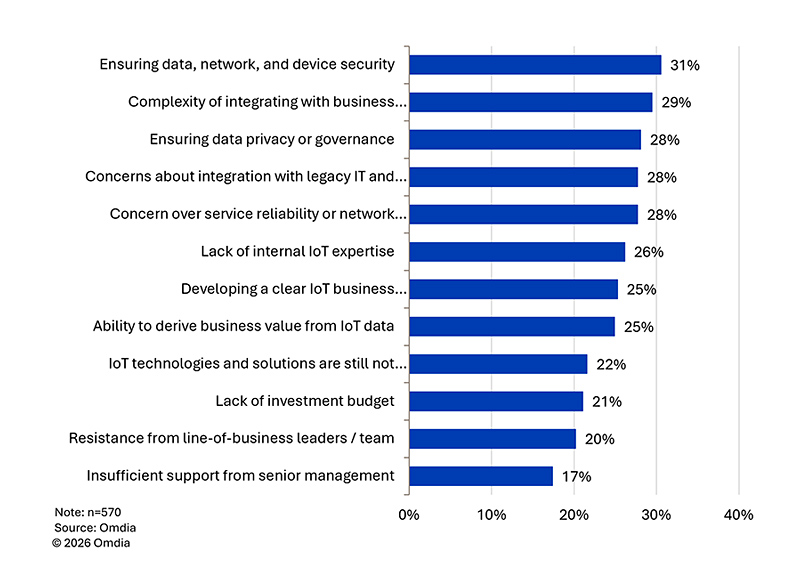
Moving beyond pilots, however, introduces challenges that are less visible in isolated proof-of-concept deployments. Security was the most frequently cited obstacle to IoT adoption among respondents with edge environments, selected by 31%.
Integration issues followed closely. Connecting edge deployments with operational technology and existing business processes was cited by 29% of respondents, while 28% identified integration with legacy IT systems as a challenge.
Those figures illustrate an important consequence of distributing computing closer to physical operations: edge architectures can reduce dependence on centralized infrastructure while simultaneously increasing the number of systems, interfaces and locations that enterprises must manage. Security therefore becomes an architectural issue across the distributed environment rather than simply a device or cloud concern. This aligns with the broader shift toward secure-by-design IoT architectures as connected systems become more distributed.
Only 21% of respondents cited lack of budget as a major obstacle. That gap is revealing. It suggests that for many organizations, the next constraint on edge adoption is not obtaining funding for computing infrastructure, but making distributed systems work reliably with existing OT, IT and security environments.
Integration becomes part of the edge opportunity
For technology suppliers, this changes where much of the value may lie. Edge hardware and processing capability remain important, but enterprises operating across factories, warehouses, utilities or other distributed environments must also manage heterogeneous equipment, multiple vendors and existing operational systems.
That creates a larger role for platform providers, cybersecurity vendors and system integrators able to manage edge infrastructure across multiple sites while connecting it with enterprise applications and operational workflows.
For OEMs and industrial users, the Omdia results also reinforce the importance of considering lifecycle management and integration requirements early in an edge deployment. A successful pilot running at one location does not necessarily expose the security, interoperability and operational complexity that appears when the same architecture is replicated across dozens of facilities.
With more than half of surveyed edge adopters already reporting moderate or extensive deployment scale, edge computing appears to be entering that more demanding phase. Its next stage of adoption may depend less on proving the benefits of processing data locally than on making distributed edge infrastructure manageable as part of the wider enterprise IoT environment.
 ChatGPT