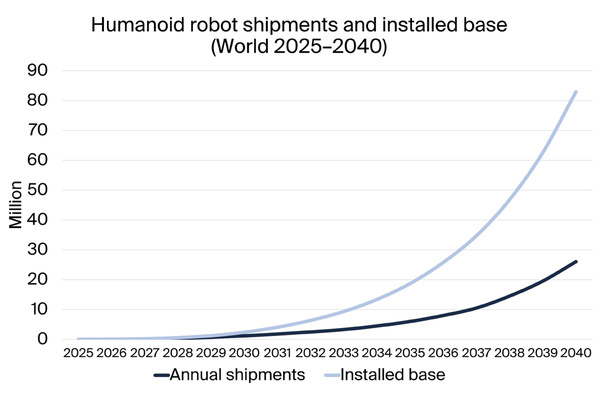
Berg Insight expects annual humanoid robot shipments to rise from 16,000 units in 2026 to 26 million by 2040, while cellular connections associated with humanoid robots could reach 50.6 million over the same period.
Humanoid robots have spent years attracting attention through demonstrations and prototype programs, but their commercial significance will ultimately depend less on individual machines than on whether vendors can manufacture, deploy and manage them at scale. New forecasts from Berg Insight suggest that this transition is beginning, with production volumes expected to increase sharply over the next decade and beyond.
The research firm forecasts annual humanoid robot shipments to grow from 16,000 units in 2026 to 26.0 million units worldwide by 2040, equivalent to a compound annual growth rate of 63.7 percent. It expects the corresponding market value to rise from US$890 million to US$554 billion.
From prototypes to production systems
More than 100 companies are now developing full-size humanoid robots, according to Berg Insight. Most remain at the research, prototype or pilot deployment stage, but a smaller group is beginning to scale production or prepare for larger commercial manufacturing.
The report identifies Figure AI, Tesla, Agility Robotics, Boston Dynamics, Apptronik, 1X Technologies, NEURA Robotics, Unitree Robotics, UBTECH Robotics, AgiBot, Leju Robotics, EngineAI and RobotEra among the companies shaping the current market.
What distinguishes the current phase from earlier waves of robotics development is therefore not simply improved robot capability. Berg Insight points to the simultaneous emergence of dedicated manufacturing facilities, commercial deployments and substantial investment in companies attempting to turn humanoid platforms into repeatable products.
Investment activity accelerated during 2025 and 2026, with multiple robotics companies completing major funding rounds. NVIDIA, Microsoft, Google, Amazon, Hyundai and OpenAI are among the strategic investors increasing their involvement. Berg Insight also sees partnerships and transactions becoming more important as companies seek embodied AI technology, engineering resources, manufacturing capacity and deployment opportunities.
Connectivity becomes part of the deployment architecture
For the IoT industry, one of the more significant elements of Berg Insight’s forecast is the expected rise of cellular connectivity in humanoid robots. The firm estimates that cellular subscriptions associated with these machines will increase from 5,000 in 2025 to 50.6 million in 2040, representing an 84.9 percent CAGR.
Cellular connectivity can support remote monitoring, diagnostics, fleet management, software updates and access to cloud-based services. These are familiar functions in other connected machine categories, but their importance increases as humanoid robots move from isolated pilots into fleets distributed across commercial environments.
This also points to a practical shift in how such robots may need to be managed. Once deployed in volume, a humanoid robot becomes not only an autonomous machine but also a connected endpoint with software, remote-management and lifecycle requirements. For OEMs and system integrators, that expands the design problem beyond mechanics and onboard AI to include connectivity management and reliable access to backend services.
Software and manufacturing become competitive factors
Berg Insight argues that competition is already moving beyond hardware performance alone toward embodied AI, software ecosystems and scalable manufacturing. That distinction matters because advances in locomotion or manipulation may attract attention, but commercial deployments will also depend on whether vendors can reproduce those capabilities economically across large numbers of machines.
The forecast also implies an expanding role for connectivity providers and IoT platform vendors if humanoid deployments reach the volumes Berg Insight anticipates. Managing tens of millions of connected robots would create requirements around provisioning, diagnostics, remote software distribution and fleet visibility that closely resemble established IoT device-management challenges, although applied to substantially more complex endpoints.
The scale of Berg Insight’s forecast remains a long-term projection, but the more immediate signal is that humanoid robotics is beginning to move from experimental development toward an industry concerned with manufacturing, software ecosystems and connected fleet operations.
 ChatGPT