

Nearly 6 million Home Energy Management Systems were installed across Europe and North America by the end of 2025, according to Berg Insight, with Europe accounting for the vast majority. The next stage of the market is increasingly about coordinating solar generation, batteries, EV charging, heat pumps and other connected energy assets rather than simply adding storage capacity.
Residential electrification is turning energy management into an increasingly complex IoT problem. A household equipped with solar panels, battery storage, an EV charger and a heat pump may have several flexible energy assets, but extracting value from them depends on their ability to operate as a coordinated system rather than as isolated devices.
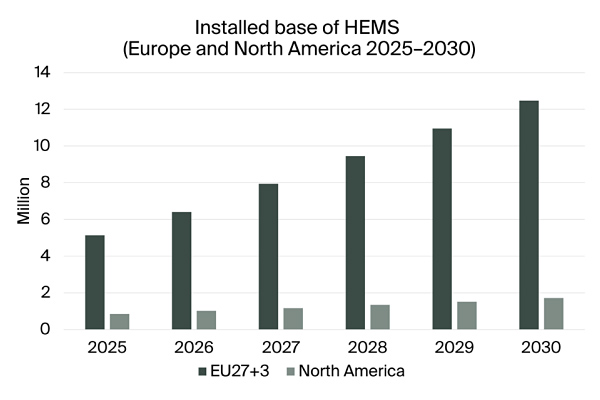
That shift is becoming visible in the Home Energy Management Systems (HEMS) market. Berg Insight estimates that the combined installed base in Europe and North America reached approximately 6.0 million systems at the end of 2025, with Europe accounting for around 5.1 million installations and North America for another 850,000.
The research firm uses a relatively specific definition of HEMS: a system must at minimum combine solar photovoltaic generation, battery storage and a web portal or smartphone application providing remote monitoring and control. More extensive deployments can incorporate generators, EV chargers, heat pumps, appliances and other connected equipment.
Europe emerges as the larger HEMS market
Europe remains considerably ahead of North America. Around 1.3 million systems were added to the European installed base during 2025, including both new solar-plus-storage installations and batteries retrofitted to existing photovoltaic systems.
Despite that growth, Berg Insight calculates that HEMS penetration remains at only 4.3 percent in Europe. Germany represents almost half of both the region’s installed base and annual shipments, making it the dominant European market.
The research firm expects the European installed base to grow at a compound annual rate of 19.4 percent to reach 12.5 million systems by the end of 2030. That would raise penetration to approximately 10 percent.
North America remains substantially less penetrated. Berg Insight estimates that 850,000 HEMS were installed at the end of 2025, while approximately 200,000 new systems and retrofits were shipped during the year. Only 0.7 percent of houses and multi-dwelling units in the region were equipped with a HEMS.
The US represents roughly 95 percent of the North American market, with California, Texas, Hawaii, Arizona and Puerto Rico among the largest markets. Berg Insight forecasts the regional installed base to exceed 1.7 million systems by 2030, based on a 15.2 percent CAGR, bringing penetration to around 1.4 percent.
The control layer is becoming as important as the energy hardware
What distinguishes the evolving HEMS market from conventional smart-home energy monitoring is the combination of physical energy assets with an increasingly sophisticated software control layer. The challenge is no longer limited to displaying household electricity consumption. Systems can potentially have to coordinate battery charging, photovoltaic production, EV charging and heating while responding to electricity prices, export tariffs and changing household demand.
This creates an important implication for the IoT ecosystem: adding more connected energy equipment also increases the value of interoperability. A household containing equipment from several manufacturers requires software capable of exchanging data with those devices and making coordinated decisions across them. Integration therefore becomes a larger part of the HEMS opportunity as installations become more heterogeneous.
The vendor landscape already reflects that distinction. Alongside integrated energy-system providers such as Tesla, Enphase Energy, Sonnen, SolarEdge, Huawei, Sungrow and SMA Solar, Berg Insight identifies companies including GridX, Kiwigrid, Clever-PV, Eniris, Homey, Greenely and Tibber that focus on hardware or software platforms capable of integrating batteries, chargers, heat pumps and smart-home devices from multiple manufacturers.
For device manufacturers and system integrators, this evolution shifts part of the competitive requirement toward interfaces, device interoperability and lifecycle integration. For energy providers and connectivity platforms, meanwhile, increasingly connected residential energy assets create a larger distributed infrastructure that can be remotely monitored and managed.
The numbers suggest that HEMS remains an early-stage market despite rapid European growth. The more significant development is therefore not simply the rising number of residential batteries. As homes accumulate controllable energy assets, the HEMS is evolving into an orchestration layer connecting those assets with household consumption, electricity pricing and the wider energy system.
 ChatGPT